Starch-Free Success Stories Guest Blog: Merryl Catlow


After living with unexplained pain for most of her life, Merryl was finally diagnosed with Spondyloarthritis in her late 50s. Instead of following a conventional medical route, she turned to diet and exercise to manage her symptoms – and in doing so, found relief in ways she never expected.
Merryl’s story is not only inspirational but also informative. I love how she’s written about what a starch-free diet looks like in her life on a daily basis. Definitely check out the resources she shares below as well – they are so valuable and a key to success for many!
Merryl’s post is part of the “Starch-Free Success Stories” series.
The Early Signs: When Pain Became Normal
My journey with Spondyloarthritis (AS) started long before my diagnosis. From a young age, I sensed I was “different”- not in the way children sometimes dream of being extraordinary, but in a quieter, puzzling way. At school, I wasn’t flexible like other kids. I could run fast and excelled at netball, but when it came to gymnastics, or vaulting over the gym horse, I’d freeze. My body simply didn’t cooperate the way others’ did – as if there was an internal resistance I couldn’t explain.
By the time I reached puberty, I was dealing with a handful of unexplained aches: in my ankles and feet (dismissed as flat feet), my jaw (written off as stress), and later, my hips and spine joined the chorus of discomfort. A therapist even told me I needed more “ooh & ahh” in my life – that I just needed to relax. That became a recurring theme.
I assumed that was just life – that everyone probably hurt somewhere. To manage it, I relied on regular massages and occasional chiropractic adjustments when sciatica flared. Each session left me feeling blissful, as if I was walking on air, but by the next day, the pain returned, persistent as ever.
In my twenties, I trained in aromatherapy massage — partly out of interest, partly in search of self-healing. I remember preparing oils for a friend I was practicing on, and casually asking, “Where does it hurt?” I wasn’t expecting his answer to be “Nowhere.” That was when it hit me—not everyone lives with pain.
But I did. For years.
The Moment Everything Changed
Despite eating well and living a healthy lifestyle, the pain remained constant. Scan after scan showed nothing remarkable, and still, my body hurt.
The turning point came in my late 50s, when my neck suddenly locked and I couldn’t move my head. That alarming incident led to a quick GP visit—and an unexpected question: “Have you heard of Spondyloarthritis?” I had, surprisingly. My sister had been diagnosed the year before, but I’d assumed her condition was isolated to her shoulder. This time, though, it all lined up. A blood test confirmed I have the HLA-B27 gene.
That test was the key to finally understanding my body. A rheumatologist confirmed the diagnosis through scans and recommended medication to prevent further damage. While medication was an option, I’ve always preferred to explore natural approaches whenever possible — and that’s when I discovered the pioneering research of Professor Alan Ebringer.
A Radical Shift: The No Starch Diet
Ebringer’s research linking gut health to autoimmune inflammation was a revelation. Around that time, I also met Sean Codling (of stopas.co.uk), a former AS patient of Professor Ebringer and a passionate advocate for sharing his findings. Sean introduced me to the No Starch Diet—a way to reduce inflammation by eliminating starch, the fuel that feeds the gut bacteria associated with Spondyloarthritis.
I was fortunate to attend one of Professor Ebringer’s talks in London and even joined a small group discussion afterward. He took the time to thoughtfully explain the science, making it both clear and practical for our own circumstances. That meeting was a turning point—it finally gave me a hopeful and practical path forward.
Soon after, I joined the Facebook support group The Low/No Starch Lifestyle for Ankylosing Spondylitis, and my new lifestyle began. I didn’t go through a formal elimination phase—by then, I already had a good sense of certain foods that triggered my symptoms. I committed fully to cutting out starch, and the effects were almost immediate. The pain didn’t vanish overnight, but water retention eased, my weight stabilised, and—most importantly—my body felt relieved, like it could finally relax.
Movement as Medicine
I complemented the diet with consistent movement. It wasn’t about intense workouts—I’ve always walked a lot, and I joined a gym to help keep my body active every day. I also made a conscious effort not to sit for too long. Over time, I began to feel better than I had in decades.
Although some structural damage had already occurred—including small bone spurs and a cartilage tear in my hip—there’s been no fusing, and this new lifestyle keeps my pain manageable. To protect my gut, I avoid taking painkillers and instead rely on stretching, massage, Pilates, Epsom salt baths, acupuncture, chiropractic care and aromatherapy, as needed.
The Scan That Said It All
The real turning point came during a routine rheumatology appointment. My doctor reviewed my latest MRI and told me the inflammation in my spine—and the enthesitis (inflammation of tendons and ligaments) that had previously appeared—was now gone.
Smiling, he said he’d stop trying to persuade me to take medication and added, “Carry on doing what you’re doing.”
That moment confirmed I was on the right path. No more pressure, no more doubt.
Navigating the No-Starch Diet: Overcoming Early Challenges
Starting the no-starch diet was a major shift. It wasn’t just about cutting out bread, potatoes, or pasta—starch hides in so many unexpected places, and adjusting took time.
Even knowing the potential benefits, the early days were tough. The diet felt restrictive—sometimes even isolating—and the idea of maintaining it long-term felt overwhelming. On top of that, pain flares would appear without warning or clear cause, which really tested my commitment.
But one of the most encouraging discoveries was that I wasn’t alone. There’s a growing community of people navigating the no-starch lifestyle—sharing experiences, insights, recipes and support. That sense of connection made all the difference.
What Works For Me
Before this journey, I was already steering clear of sulphites and carrageenan, so cutting out processed foods wasn’t new to me. Now, I eat almost exclusively home-prepared meals and use iodine to test anything I’m unsure about for starch.
One of the biggest lessons I’ve learned is that I can’t let myself go hungry. Having spent years trying various diets when I was younger, I’ve learned that depriving myself backfires—it usually leads to bingeing on things I’m trying to avoid. So now, I make sure to eat well at every meal until I feel properly satisfied. And when I’m out for the day and unsure what food will be available, I make sure my bag is stocked with safe snacks and treats to get me through.
A Typical Day of Eating
On a usual day, I’ll eat something like this:
Breakfast could be a combination of berries, cucumber, avocado, goat cheese, a handful of compliant nuts, and eggs.
Lunch is often fish or chicken with a generous serving of compliant vegetables.
Dinner might be a repeat of lunch, or a mix of eggs, salads, herbs and flavour-packed dressings.
Snacks on the go: macadamia nuts, coconut balls, compliant bread/cake, cucumber/celery & cheese, cheese-stuffed mushrooms, boiled eggs, tinned sardines, cold meat/fish, roasted seaweed sheets, berries, 85-100% chocolate
It may sound limited, but I really enjoy what I eat. The variety comes from how I cook, the mix of vegetables and the endless ways to use herbs, spices, dressings and oils (avocado, olive, walnut).
Treats Redefined
I do eat berries regularly and the occasional apple, but sugar in any form—whether it’s fruit, honey, chocolate, or even compliant baked goodies—is something I keep for special occasions. That said though, daily treats are essential! I’ve reframed what “treats” mean for me. A spoonful of pure cocoa often satisfies my chocolate craving, a handful of macadamia nuts is really satisfying, dehydrated salmon skins for that salty crunch, or an indulgent piece of special cheese. Treats are personal—it’s just about finding what feels indulgent for you, without compromising the goals.
Eating Out
At first, I avoided eating out—it just seemed easier than dealing with the uncertainty. But over time, I’ve found places that either offer suitable options straight from the menu or are happy to adjust a dish to fit my needs, and now it no longer feels like I’m missing out.
I’ve also learned how to approach meal planning with friends. Some have told me they’d rather see a list of what I can eat instead of what I can’t—so that’s exactly what I share now. My friends have been consistently supportive, creating delicious, thoughtful meals and treats that work perfectly for me, and that everyone at the table enjoys. I’ve even taken home a few recipes to recreate myself!
Over time, things begin to balance out. I have adapted, it starts to feel more normal, and the day-to-day choices become second nature. For me, that shift also brought a sense of gratitude—that this is something we do have some control over. That feeling of taking action, of doing something that helps, is empowering. And as the benefits start to show, the effort feels more manageable and absolutely worth it.
Community & Resources
When I first started navigating the no-starch diet, these were the places I kept coming back to. Each one offered something valuable. I’m incredibly grateful to everyone behind these resources.
Facebook Group
The Low/No Starch Lifestyle for Ankylosing Spondylitis
A friendly, active and well-managed community where members share practical advice, real experiences and no starch recipes.
Join the group here
Websites
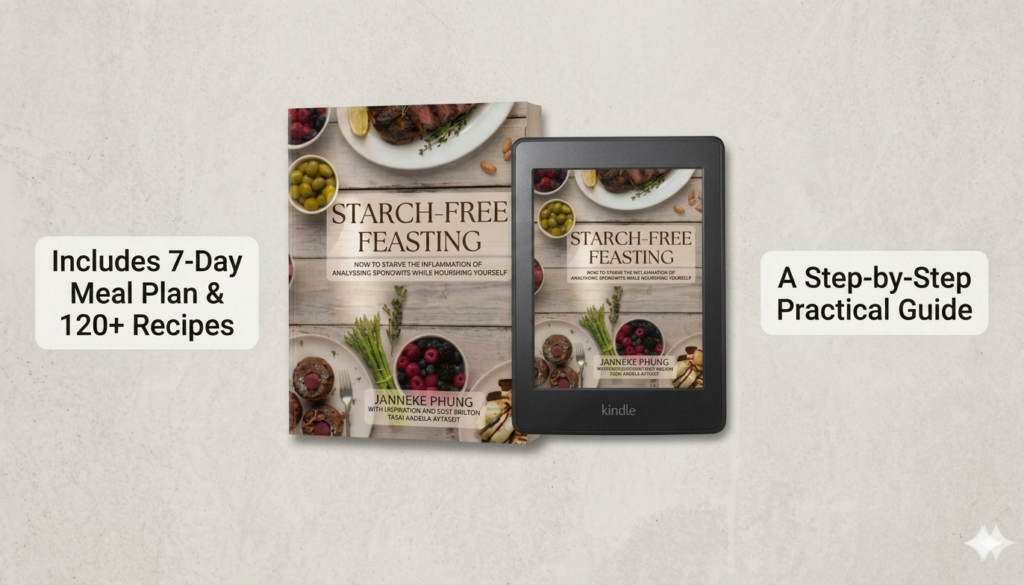
Starch-Free Feasting by Janneke Phung
An inspiring collection of delicious no-starch recipes – including breads, desserts and comfort foods you thought you’d have to give up.
Visit starchfreefeasting.com
KickAS.org
A trusted, long-standing resource for people with AS—offering shared knowledge, lived experience, and a strong sense of community.
Visit kickas.org
Book
The Keystone Approach by Rebecca Fett
A science-backed approach to managing autoimmune conditions, especially relevant for AS and getting started on the no-starch diet.
Food Ingredients (UK)
Real Food Source
Bulk nuts, seeds, nut butters, compliant flours, cocoa and more. (Watch for added starch in products like coconut milk).
Visit realfoodsource.co.uk
My Everyday Motivation to Keep on Trucking
I used to think everyone lived with pain. Now I know better and staying well is my goal.
My motivation is to remain as strong and flexible as possible — so I can keep up with my family, dive into spontaneous moments, scramble around on the floor and power through the day without flagging. Life moves fast, and I don’t want to be left behind. With our campervan ready to roll and countless adventures ahead, I’m fuelled by the freedom to travel, trek and explore wherever the road takes me. I know I’m not invincible — ageing and AS both bring their challenges — but I’m realistic, resilient, and determined to stay active for as long as my body allows.


No Comments